The feeling first
You notice it on stairs. Going down, the first few steps feel careful, like the joint wants oil. On grass or gravel you slow up and watch your feet. First thing in the morning the walk across the floor is flat and stiff, and in a deep squat your heels float up off the ground.
None of that means something is wrong. Ankles get stiff the same way hips and hamstrings do: from days that never use them. Shoes hold them in one position. Chairs keep them parked. Flat floors give them nothing to do. Then you step off a curb or head down the stairs, the ankle has to move for the first time all day, and it feels slow.
Stretching is the familiar half
Search for ankle mobility exercises and what you get is mostly stretching. Calf stretches at a wall. A knee driven out over the toes. Circles. None of it is wrong. Stretching is the best-tested way to make a joint feel looser, and the effect on range of motion is large and reliable. Pooled across 77 studies, stretching improves range with one of the better-established effects in the field (Konrad 2024, Journal of Sport and Health Science). The ankle research agrees on its own narrow point: in studies of people getting range back after an ankle sprain, static stretching restored ankle range better than any other tool tested (Terada 2013, Journal of Athletic Training).
So stretch. If the back of your ankle feels short when you sink your weight forward, calf work is the right tool for that feeling.
But loose is only half of what you want from an ankle. That careful feeling on gravel isn't tightness. It's steadiness, and steadiness is its own kind of training.
What the research found
The strongest ankle evidence comes from an unlucky group: people who sprained an ankle and didn't want to do it again. You don't need a sprain story of your own for the finding to matter, because it says something plain about what ankles respond to.
The National Athletic Trainers' Association position statement on ankle sprains grades each of its recommendations by the strength of the evidence behind it. Exactly one earns an A for reducing reinjury: balance training. Range of motion, flexibility and strengthening work together earn a B. The statement adds a detail worth keeping. Balance work should run all the way through a programme, not sit at the end as a finisher.
The best home-sized test of the idea is a trial of 522 athletes (Hupperets 2009, BMJ). Eight weeks of balance work at home, three sessions a week, each under 30 minutes, no supervision. Among those who got usual care alone, 33 in 100 sprained an ankle again. Among those given the balance programme, 22 in 100. One fewer re-sprain for roughly every nine people who did the work. And only about a quarter finished the programme exactly as written. The ones who did saw a much larger difference.
The balance evidence has its own wobble: one pooled analysis found no significant drop in recurrence, and in one trial a simple brace did better.
Now the other side of the ledger. No trial shows that stretching, or getting ankle range back by any means, lowers the chance of a re-sprain. The programmes that moved that number were built from balance and strength work. Stretching wasn't a component of any of them.
Those are findings about groups in trials, not promises about your ankles. But they're a strong argument about where your ankle minutes should go. Stretching makes an ankle looser. Balance work is what teaches it to hold you up.
A session that carries both
Here is what both halves look like together, in about seven minutes, all of it standing.

Ankle Circles, 30 seconds a side. Stand on one leg, or rest a hand on a wall, and draw slow circles with your foot. Big circles, both directions. You're warming the joint, and the standing leg is already balancing a little.

Heel-to-Toe Rocks, 30 seconds. Rock up onto your toes, back onto your heels, and keep rolling. It wakes the feet and calves, and your ankles start making small decisions about where your weight is.
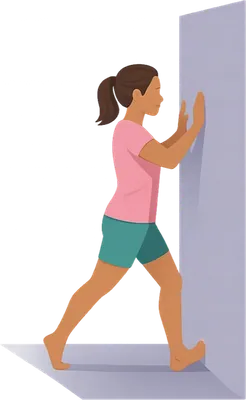
Toe-to-Wall, 45 seconds each side. Toes a hand's width from a wall, knee driving forward to touch it, heel heavy on the floor. You feel this one deep in the back of the ankle. This is the range work, and it's worth the full minute.
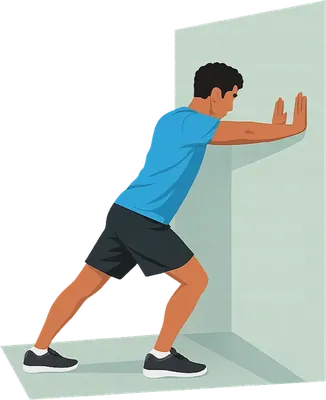
Leaning Calf, 45 seconds each side. Step back, lean into the wall, back leg long, heel down. The long, familiar calf stretch. Let it be boring.
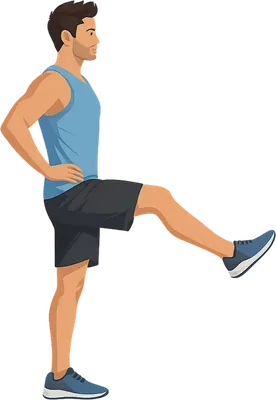
Single Leg Stand, 30 seconds a side. Lift one foot and stand tall. It looks like nothing. Then the standing foot comes alive: small corrections, the ankle firing this way and that to keep you upright. The wobble is the exercise. You're not trying to be perfectly still. You're practicing the catch.

Calf Raises, 30 seconds. Rise up onto your toes, pause at the top, lower down slow. Strength for the calves, and a small balance test at the top of every rep.
Warm it, stretch it, then make it hold you up. That's the whole shape.
Where the balance goes matters
One design detail from the trial is easy to miss. The home programme didn't save its balance work for the end. It was spread through each session, so the ankle kept coming back to steadiness between other work. The position statement says the same thing: all the way through, not last.
Most routines do the opposite. Balance shows up in the final minute, if it shows up at all, on ankles that are already tired and a mind that's already done.
Our long ankle session spreads it out instead. Single-leg stands appear three times across twelve minutes, with calf and toe work in between, so you keep returning to steadiness while the joint is warm. Each visit feels a little different because of what came before it.
If you want it on a timer
Zenbody is an iOS app that runs sessions like this one movement at a time, with a drawn figure to follow and a timer, so you're never checking a list mid-stretch. The ankle work comes in three sizes. Ankle reset is built from the session above. Ankle rebuild is the long one, with the balance work woven through it rather than saved for the end. And there's a short one for the morning, Ankle rocks, for before your feet have carried anything. All three live on the ankles and feet page.
However you run it, keep the rule of thumb. When you give your ankles time, spend some of it on one foot. Stretching makes them feel looser the same day. The balance work is the half the research keeps pointing at.